
Dentures or implant-retained dentures: what changes day to day
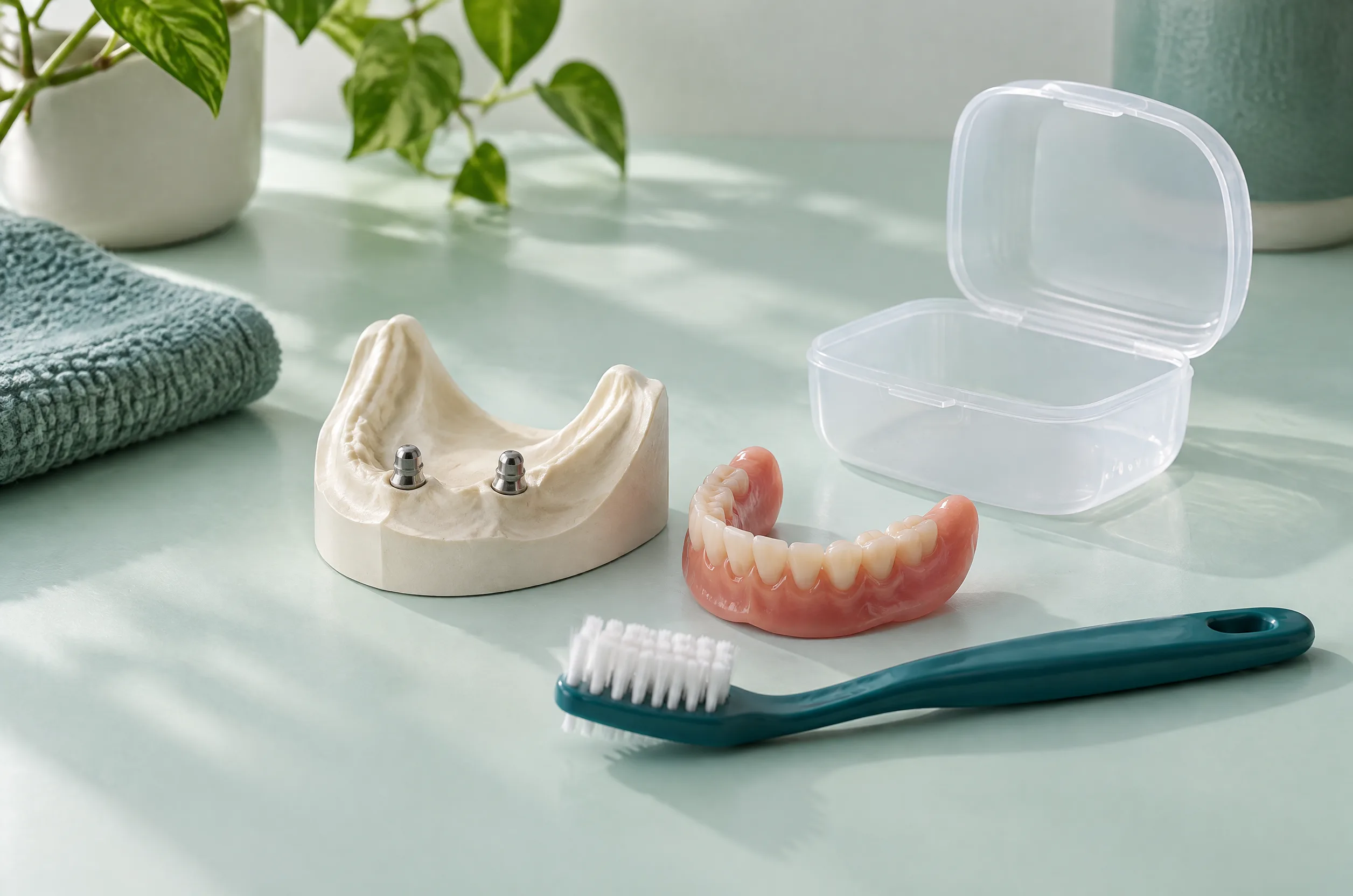
Choosing replacement teeth means thinking about ordinary days: eating breakfast, cleaning your mouth and taking the teeth out at night. A conventional full denture rests on your gums. An implant-retained denture fits onto implants in the jaw and is still removable. The difference is how it is held in place, not whether it needs ongoing care. [1]
The phrase “implant-supported teeth” can also be used in conversations about other designs. Ask exactly which appliance is proposed and whether you remove it yourself. This article compares conventional removable dentures with removable implant-retained dentures; it does not treat every full-arch replacement as the same thing.
What is the practical difference between the two?
Healthdirect describes three main denture types. A full denture replaces all the teeth in an upper or lower jaw and rests on the gums. A partial denture replaces some teeth and uses clasps around remaining teeth. An implant-retained denture is fitted onto implants in the jaw and can be removed. Those distinctions matter when someone simply says “dentures”. [1]
At Joondalup City Dental we offer removable dentures, and our implant types information describes implant-retained dentures, which use implants to anchor a removable denture. At your appointment, ask us to show you which design is being discussed and explain how you would put it in, remove it and care for it. [3] [4]
It is reasonable to ask for the proposed appliance's name in writing. That makes it easier to compare the daily routine, treatment stages and costs without accidentally comparing a removable denture with a different kind of restoration.
What should I expect when eating and speaking?
New dentures can feel unfamiliar. Healthdirect advises starting slowly with soft foods and explains that adjustment can take months. Dentures can feel awkward or loose, cause soreness and increase saliva while you are getting used to them. These are limitations to discuss, not reasons to expect an immediate return to your usual routine. [1]
Our denture page also describes an adjustment period, possible difficulty with eating and speaking, and practising speaking out loud. It suggests starting with soft foods and cutting food into smaller pieces. Ask which advice applies to the particular denture and stage of care being proposed for you. [3]
If implants are involved, ask separately about the period after surgery and the period after denture fitting. Healthdirect advises following your dental professional's instructions while an implant site heals. Advice for an established denture is not a substitute for your surgical aftercare plan. [2]
What changes in the daily cleaning routine?
A removable denture comes out for cleaning. Healthdirect recommends cleaning all its surfaces with a soft toothbrush and mild soap and water; toothpaste can scratch denture surfaces. It advises cleaning in the morning, before bed, after food and when necessary. Ask the dentist to demonstrate the method for your own appliance. [1]
Your mouth needs care too. Healthdirect advises brushing gums and tongue daily even if you have no natural teeth. If you have remaining teeth or implants, ask for a cleaning routine that covers those as well as the denture. [1]
Once implants have healed, Healthdirect recommends brushing and cleaning between implants and neighbouring teeth, with regular dental checks. The method for reaching your own attachments and surrounding tissues needs to be shown to you; do not assume that cleaning the removable teeth is the whole routine. [2]
A useful consultation question is: “Can I practise removing and cleaning this before I take it home?” If handling a brush or appliance is difficult, explain what is difficult so you can ask about the routine in practical terms.
Do I take removable dentures out at night?
Healthdirect advises removing dentures before bed to give the mouth time to rest. After cleaning, it says storage can be in a clean dry container or a container of water, and to ask your dentist which is appropriate. Get instructions for your denture rather than assuming every material and design is stored the same way. [1]
Our denture page also suggests taking dentures out while you sleep so your gums can rest. It warns against hot water, which can warp the plastic and damage the denture. Ask about the care products and storage method for the design you actually receive. [3]
If your dentist has given you a different instruction for a particular stage of treatment, ask them to explain how long that instruction applies. Keep it with your written care information.
What appointments are involved, and are implants suitable for everyone?
Making and fitting dentures often takes several appointments, and adjustments may be needed afterwards. Healthdirect explains that dentures fitted after extractions can need changes as the gums heal. Ask which visits are part of making the denture and which are follow-up checks. [1] If removing teeth is part of your plan, see our tooth extractions information before your visit.
An implant-retained option also involves assessing and placing implants. Healthdirect describes checking bone, gums, medicines and medical conditions, followed by staged treatment and healing. Implant surgery is not appropriate for every person. Risks include infection, nerve damage, sinus problems and damage to surrounding teeth. [2]
A conventional removable denture is one alternative to implant treatment; a bridge may be relevant in some situations. Ask your dentist to explain the suitable choices, their limitations and their costs for your mouth. An attachment system alone does not establish that the additional surgery is warranted. [2]
For a separate explanation of the appointment order, see what happens at each implant visit.
What if the denture rubs, feels loose or makes my mouth sore?
Arrange a dental assessment rather than treating persistent discomfort as something you must put up with. Healthdirect recommends seeing your dentist if you have soreness, bleeding gums, swelling or ulcers; the denture may need adjustment. Our denture page also recommends regular check-ups to monitor fit, because the shape of your gums and jawbone can change over time. [1] [3]
If a denture is damaged, contact us rather than using household adhesives or do-it-yourself repair kits. Tell the team what has changed and keep the appliance available for assessment. [3]
You can describe where it rubs, which meal is difficult or whether something has broken without knowing the cause. Ask how soon the team wants to assess it and what to do until then.
How can I discuss the choice without focusing only on the attachment?
Take questions about your day, not just the name of a treatment:
- Will I remove these teeth myself, and can you show me how?
- How do I clean the denture, my mouth and any attachments?
- What can I eat during each stage, and when should I ask for advice?
- Which fitting, surgical and adjustment appointments are included?
- What are the risks, alternatives and ongoing costs?
- What should prompt me to contact the clinic?
To talk this through with us, start with our denture service information or contact Joondalup City Dental to discuss an assessment. Choosing a design requires individual advice; this article does not recommend implants or dentures for every missing tooth.
Sources and article information
Prepared 12 November 2026. Sources checked 16 November 2026. General Australian patient information, not a personal treatment or cleaning plan. No treatment outcome is promised.
- Healthdirect: Dentures — patient guidance, reviewed February 2025.
- Healthdirect: Dental implant — patient guidance, reviewed February 2025.
- Joondalup City Dental: Dentures.
- Joondalup City Dental: Implant types.
By Tony Strangio. Authorship does not imply a separate clinical review.


 Unhappy With My Smile
 I Have Missing Teeth
 Unhappy With My Dentures
 My Teeth Are Stained or Discoloured
 Considering Teeth Straightening
 Want a Full Smile Makeover
 I Have a Dental Emergency
 Seeking Smile Improvement
 Help With Dental Anxiety
 General Dentistry
 Cosmetic Dentistry
 Restorative Dentistry
 Dental Implants
 Orthodontics
 Emergency Dentist
 Sedation and Sleep Dentistry
 Health Funds
 HBF
 Medibank
 HIF
 HCF
 AHM
 Bupa
 CBHS
 Nib Preferred Provider
 Payment Plans
 Afterpay
 Humm
 Pretty Penny Finance
 Medipay
 Fund My Dental
 Government Schemes
 Dental Services DVA Card Holders
 Child Dental Benefit